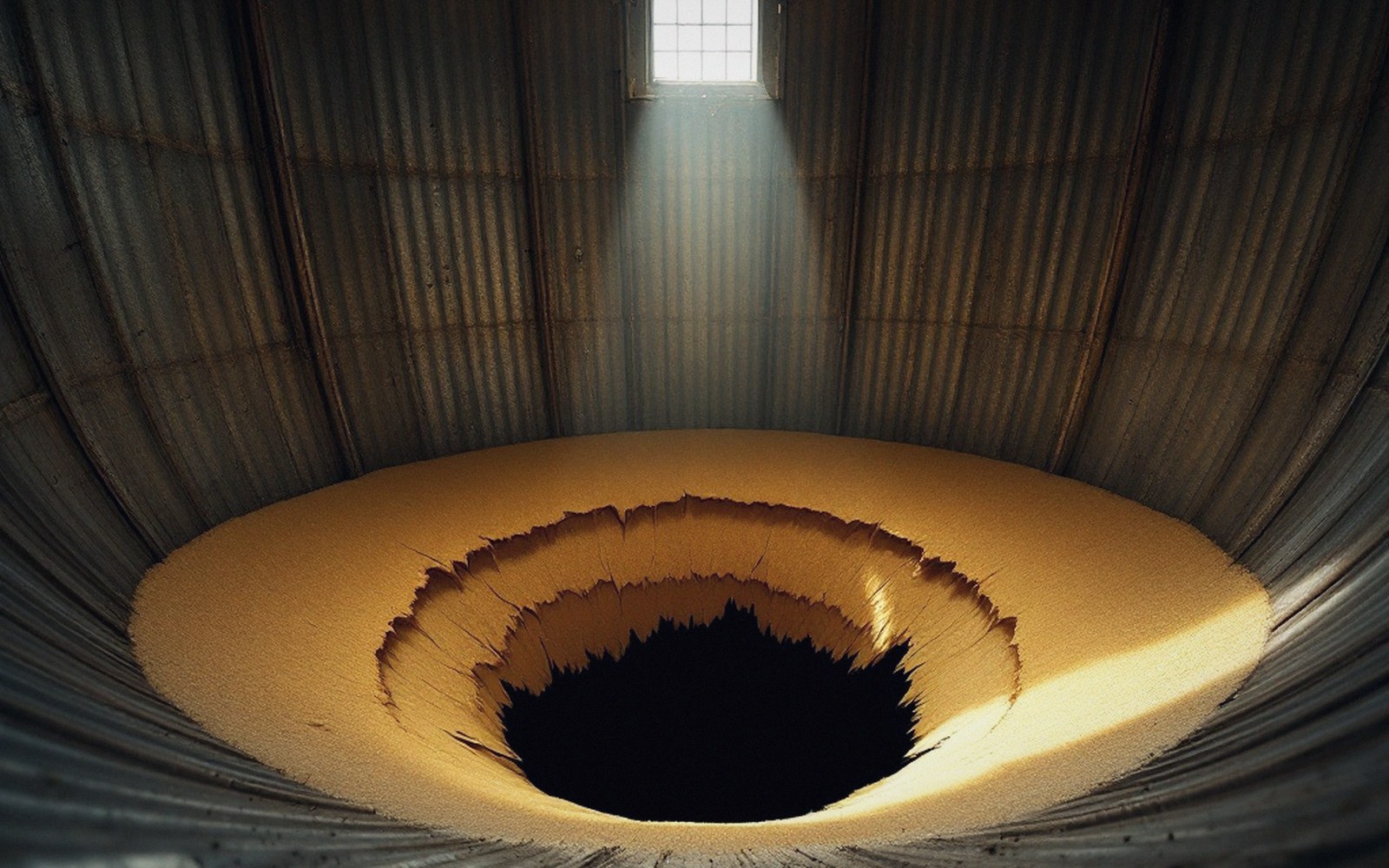
When the grain stops moving and the bin does not
Grain in a bin should flow like a slow liquid — drawing down from the top, feeding steadily into the auger below. When it stops, the problem is rarely mechanical. The bin is full. The auger is running. Nothing is coming out. What has happened is that the grain has found a way to hold itself up.
Bridging is the formation of a stable arch across the cone or the outlet throat. Individual kernels interlock — rough hulls, broken grain, and fines contributing most — and the arch transfers the weight of the column outward to the bin wall instead of down to the opening. The auger runs in empty air beneath it, moving nothing. From outside, there is no indication anything is wrong except the absence of flow.
The other failure is a rathole: a narrow channel punches through from outlet to surface while the surrounding mass stays locked in place. Material flows until the channel is clear, then stops. The rathole looks like progress — grain moved, tonnage registered — but most of the bin is untouched, and what remains may be the oldest, most degraded grain in the store.
The arch fails without warning, the grain below it is moving, and anyone above the grain surface is drawn in faster than they can be pulled out.
Both failures are more likely when moisture is uneven. Grain binned above fourteen percent in rice, or above thirteen in soybeans, tends to pack. Fines — broken kernels, hull fragments, chaff — migrate toward the center of the bin during fill, building a dense column exactly where the draw-down cone will try to form. That central column packs tighter than the cleaner grain at the perimeter, and it bridges first.
Crust is a related but slower problem. When warm, moist air contacts a cold grain mass, moisture migrates and condenses. The surface layer wets, mold follows, and the top of the bin sets into a crust that the grain below cannot break through on its own. Aeration run at the wrong time of year — pushing warm air up through cold grain — accelerates this. The bin is a machine, and like any machine it fails predictably when operated against its own physics.
Breaking a bridge or a crust by reaching in from the top hatch is how people are killed. The arch fails without warning, the grain below it is moving, and anyone above the grain surface is drawn in faster than they can be pulled out. The confined-space rules that govern bin entry exist because the failure mode is sudden and the outcome is not survivable.
The mechanical answer is a sweep auger run before the bin empties, breaking any incipient arch at full depth, or aeration designed so air moves top-down in warm weather, bottom-up in cold — keeping the grain surface dry by controlling where condensation forms.